
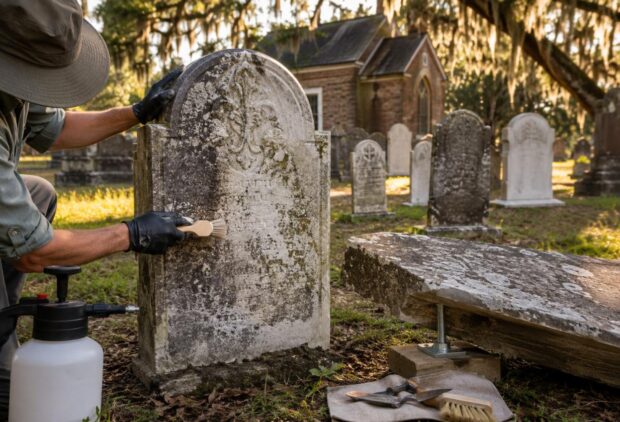
Historic churchyards around Walterboro hold more than burial sites. Their marble, granite, and other stone markers preserve family names, craftsmanship, and community history that may reach back well over a century. In the Lowcountry, those markers also face persistent humidity, biological growth, heavy rainfall, tree cover, and shifting ground.
Quick answer: Restoring a 19th-century tombstone requires a conservation-first approach. Cleaning should use gentle methods compatible with the stone, while leveling should address the marker’s support and surrounding soil without unnecessarily altering historic material. In Walterboro and surrounding Colleton County, moisture, vegetation, roots, and soft or settling soils can make both cleaning and stabilization more complicated.
What local readers should know
-
Historic tombstones should not be pressure washed, aggressively scrubbed, or cleaned with harsh household chemicals simply to make them look new.
-
Lowcountry humidity and shaded churchyards can encourage biological growth on stone surfaces.
-
A leaning marker may indicate soil settlement, root activity, drainage problems, or deterioration below ground.
-
Older marble and other weathered stones can be far more fragile than their appearance suggests.
-
Leveling a historic marker should focus on stability and preservation rather than forcing an aged monument into an unnecessarily altered position.
Why Does Historic Tombstone Restoration Matter in the Lowcountry?
Historic tombstone restoration matters in the Lowcountry because aging stone is exposed to a combination of moisture, vegetation, biological growth, and ground movement that can gradually damage both the marker and its setting. Preservation work should protect historic material while addressing conditions that could accelerate deterioration.
Around Walterboro, historic cemeteries and churchyards are part of the cultural landscape of Colleton County and the broader South Carolina Lowcountry. Mature trees can create deeply shaded burial grounds, while warm, humid conditions may leave stone surfaces damp for extended periods.
Older markers also require a different mindset than newer monuments. Weathering, softened inscriptions, surface loss, and discoloration may be part of a stone’s age. Restoration should not automatically mean making a 19th-century marker appear new.
At Steedley Monument Works, we approach monument-related work with the understanding that an older memorial deserves careful evaluation before cleaning, resetting, or other work begins.
What Local Conditions Affect Historic Tombstones?
Local moisture, vegetation, soil conditions, and long-term exposure are among the most important factors affecting historic tombstones in the Walterboro area. A marker that has stood for more than a century has experienced generations of storms, hot summers, humid weather, plant growth, and changes to the surrounding churchyard.
One particularly visible issue is biological growth. Algae, lichens, mosses, and other growth can colonize stone, especially where tree cover limits sunlight and surfaces remain damp.
Ground conditions matter just as much. Rainwater moving through a churchyard, erosion around a base, growing tree roots, and gradual soil settlement can contribute to leaning or instability.
These are best understood as local field conditions rather than a diagnosis of any particular cemetery. Each monument and burial plot should be evaluated individually before work begins.
How Can Deterioration Affect a Historic Marker?
Deterioration can affect a historic marker by weakening its surface, reducing inscription legibility, destabilizing its foundation, or increasing the chance of cracking and movement. The consequences are particularly significant when the stone carries genealogical or historical information that cannot easily be replaced once lost.
A weathered marble inscription, for example, should not be treated like lettering on a modern polished monument. Aggressive cleaning can remove weakened surface material along with staining.
Instability creates another concern. A noticeably leaning headstone may continue shifting, particularly if the underlying cause is unresolved. Simply pushing or pulling the stone upright does not necessarily create a stable repair.
For families, churches, and cemetery caretakers across Colleton County, preservation means considering both the visible stone and the conditions supporting it.
What Warning Signs Suggest a Tombstone Needs Attention?
A historic tombstone may need professional attention when it shows instability, cracking, severe surface deterioration, or changes that suggest its base or surrounding ground is failing. Early evaluation can help distinguish ordinary aging from conditions that could cause permanent damage.
Watch for:
-
A marker that has developed a noticeable lean.
-
Movement when the monument or its base is very lightly observed or assessed without force.
-
Cracks running through the tablet, base, or connection points.
-
Separation between monument components.
-
Soil erosion or depressions around the marker.
-
Flaking, scaling, powdering, or other visible surface loss.
-
Heavy biological growth obscuring inscriptions or holding moisture against the surface.
-
Nearby roots or vegetation that appear to be affecting the monument’s position.
Avoid repeatedly testing a fragile marker by pushing it. A stone that already appears unstable should be treated as potentially hazardous.
When Should a Professional Evaluate an Old Tombstone?
A professional should evaluate an old tombstone when cleaning could disturb a fragile surface, the marker is leaning or loose, components are separating, or cracks and deterioration are visible. Basic visual monitoring is reasonable, but physical intervention becomes riskier as the monument’s condition worsens.
Families can photograph a marker periodically, note changes in its lean, watch for erosion, and keep obvious loose debris from accumulating around the plot when cemetery rules permit.
DIY work should stop when the stone itself needs to be moved, reset, repaired, or aggressively cleaned. Large monuments can be extremely heavy, and seemingly solid historic stones can contain hidden fractures.
Churchyard rules also matter. Before undertaking work in Walterboro or elsewhere in the Lowcountry, determine who controls the cemetery and what authorization may be required.
What Common Conditions Cause Tombstones to Lean?
Historic tombstones commonly lean because their supporting soil or foundation has changed, although roots, drainage, erosion, and deterioration of buried components may also contribute. Identifying the likely cause is more useful than simply straightening the visible portion of the marker.
In Lowcountry churchyards, several conditions deserve attention.
Soil settlement: Ground beneath or around a marker can change over decades, allowing one side to sink.
Water movement: Heavy rain and drainage patterns can wash or redistribute soil around a monument.
Tree roots: Mature live oaks, pines, and other trees are characteristic of many South Carolina churchyards, and expanding roots can influence nearby ground.
Vegetation: Shrubs, vines, and volunteer plants can interfere with monuments and make inspection difficult.
Previous repairs: An older attempt to reset or repair a marker may itself have deteriorated.
The correct response depends on the monument’s construction and condition.
How Should 19th-Century Tombstones Be Cleaned and Maintained?
Nineteenth-century tombstones should be cleaned with the gentlest effective method and only after confirming that the stone is stable enough to tolerate cleaning. The goal is to remove harmful or obscuring material without sacrificing the historic surface, lettering, tooling, or natural patina.
Start with inspection. Look for cracks, loose fragments, scaling, granular surfaces, or movement. If the stone is fragile, cleaning should wait for professional evaluation.
Avoid pressure washing, wire brushes, abrasive pads, and harsh chemical experimentation. More cleaning force is not necessarily better, particularly on weathered marble.
Timing matters in the Lowcountry as well. Working during manageable weather conditions can provide better control than attempting conservation work during intense summer heat or immediately around periods of heavy rainfall.
Routine care should also include observing drainage, encroaching vegetation, and changes in stability.
What Results Should Families Expect From Restoration?
Families should expect responsible restoration to improve stability, cleanliness, and readability where the stone’s condition allows, not to erase 150 years of natural aging. A successful conservation-minded result respects surviving historic material and avoids unnecessary alteration merely for cosmetic uniformity.
Some staining or weathering may remain after safe cleaning. An inscription already lost through erosion cannot simply be restored by scrubbing harder.
Likewise, leveling should produce a stable monument rather than an artificial appearance that ignores how the marker was constructed and how its surrounding plot has changed.
Expectations should therefore be based on an individual assessment of the stone, foundation, soil, and cemetery setting.
What Mistakes Can Damage Historic Tombstones?
The most damaging restoration mistakes usually involve excessive cleaning, inappropriate repair materials, or moving a monument without understanding how it is supported. In an old Colleton County churchyard, a quick cosmetic fix can create problems that become apparent only after additional rain, heat, or ground movement.
Mistake: Pressure washing a stained marker.
Consequence: High-pressure water can damage weakened stone surfaces and lettering.
Better approach: Evaluate the material and condition first, then use appropriately gentle cleaning techniques.
Mistake: Scrubbing until every discoloration disappears.
Consequence: Historic surface material may be removed along with the staining.
Better approach: Accept that safe cleaning may not produce a bright, new-looking stone.
Mistake: Forcing a leaning stone upright.
Consequence: Hidden cracks or weakened components can be stressed.
Better approach: Determine why the monument moved before attempting to reset it.
Mistake: Treating every old monument alike.
Consequence: Different stones and construction methods can react differently to cleaning and repair.
Better approach: Base the work on the specific monument.
What Is a Common Historic Churchyard Scenario Around Walterboro?
A common local scenario is an older upright marker that has gradually developed biological staining and a visible lean beneath mature tree cover. The appearance may suggest a simple cleaning and straightening job, but inspection can reveal that surface condition, soil stability, drainage, and nearby roots all need consideration.
Imagine a family visiting an ancestral grave outside Walterboro and noticing that the inscription has become difficult to read. The stone also appears several degrees farther out of position than remembered.
The first priority is not making it look new. It is determining whether the marker is structurally sound, what is causing the movement, and which cleaning methods the stone can safely tolerate.
That sequence helps preserve the memorial rather than simply improve its appearance temporarily.
What Services Can Help Preserve an Older Monument?
Professional monument services can help determine whether an older marker needs cleaning, stabilization, resetting, repair, or another preservation-focused solution. The appropriate service depends on the stone’s material, construction, condition, and the rules governing the churchyard or cemetery.
Our role begins with understanding what the monument actually needs. Cleaning and leveling should not automatically be treated as one-size-fits-all procedures, particularly for 19th-century stones.
Is DIY Cleaning or Professional Restoration the Better Choice?
DIY care is best limited to low-risk observation and appropriate light maintenance, while fragile, leaning, cracked, or historically significant stones are better candidates for professional evaluation. The dividing line is whether the work could permanently alter the monument or create a safety risk.
A stable marker with limited surface debris presents a different situation from a thin marble tablet that is leaning, flaking, or fractured. Moving heavy stone, addressing failed supports, and treating delicate surfaces require greater caution.
For historic churchyards throughout the Lowcountry, preservation should take priority over speed.
Where Do We Serve Around Walterboro?
Our Walterboro location places us in the heart of the Colleton County area and within the broader South Carolina Lowcountry. Monument needs may also arise in surrounding communities and rural churchyards throughout the region.
For specific service availability outside Walterboro, contact us with the cemetery location and the type of monument involved.
What Can Happen If an Unstable Tombstone Is Left Alone?
An unstable tombstone can continue moving and may eventually suffer cracking, separation, or a fall if the underlying condition progresses. Lowcountry rain, erosion, vegetation, and continued soil movement can compound an existing stability problem, although the rate of change will vary from one site to another.
Waiting can also make preservation more complicated if deterioration progresses. Families do not need to treat every lean or stain as an emergency, but obvious movement, cracking, or loose components deserve timely assessment.
FAQ About Historic Tombstone Restoration
Can you pressure wash an old tombstone in Walterboro?
Pressure washing is generally not an appropriate default for a historic tombstone because concentrated water pressure can damage weakened stone and lettering. Older markers around Walterboro should first be evaluated for cracks, scaling, softness, and other deterioration so the cleaning method can be matched to the material and condition.
Why do old tombstones turn dark or green in the Lowcountry?
Dark or green surfaces can result from biological growth and accumulated environmental material, especially in humid, shaded settings. The Lowcountry’s warm, moisture-rich environment and tree-covered churchyards can create favorable conditions for surface growth. The exact material should be identified before deciding how aggressively, or whether, to remove it.
Can a leaning tombstone simply be pushed upright?
No, a leaning historic tombstone should not simply be pushed upright without understanding why it moved. Around Colleton County, settlement, erosion, roots, drainage, or deterioration below the visible surface may be involved. Applying force to an aged stone can also stress cracks or weakened areas.
Should an old tombstone look new after cleaning?
No, safe cleaning does not necessarily make a historic tombstone look new. A 19th-century marker may retain staining, patina, weathering, and softened details after appropriate treatment. Preservation aims to protect historic material and improve the monument’s condition where possible, rather than erase every visual sign of age.
Does Walterboro’s climate affect cemetery monuments?
Yes, Walterboro’s warm, humid climate can influence how cemetery monuments weather over time. Moisture, rainfall, vegetation, shade, and biological growth can affect stone surfaces, while water movement and changing ground conditions can influence monument stability. Actual deterioration still varies considerably by stone type, location, construction, and maintenance history.
Can tree roots cause tombstones to lean?
Yes, roots can contribute to changes in the ground around a tombstone and may affect its position. Mature trees are common features of Lowcountry churchyards, so nearby root systems should be considered when diagnosing a leaning marker. Roots are only one possibility, however, alongside settlement, erosion, and foundation problems.
Who should approve restoration in a historic churchyard?
Approval requirements depend on who owns, manages, or has authority over the cemetery or churchyard. Before cleaning, moving, repairing, or resetting a historic marker in Walterboro or elsewhere in Colleton County, families should determine the site’s rules and obtain any necessary permission rather than assuming monument work can proceed automatically.
When should a family seek help with an old cemetery marker?
A family should seek professional help when a marker is leaning significantly, loose, cracked, separating, flaking, or otherwise too fragile for routine maintenance. An evaluation is also sensible when descendants are unsure of the stone type or appropriate cleaning method, particularly with 19th-century monuments in historic Lowcountry burial grounds.
Preserve Lowcountry Memorials With Care
Historic tombstones connect Walterboro families with generations that came before them. Thoughtful cleaning and stabilization can help preserve those memorials while respecting their age, materials, and churchyard setting.
Protect a Historic Monument for the Years Ahead
Careful evaluation helps ensure that cleaning or leveling addresses the monument’s actual condition instead of creating additional damage. We can help you explore appropriate options for an aging or unstable memorial in the Walterboro area.